PRODUCT CENTER
|
|
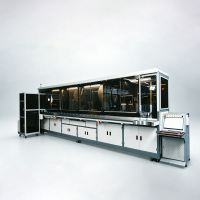
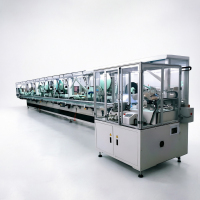
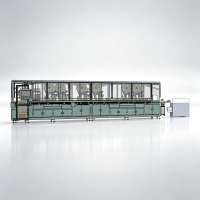
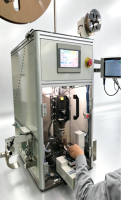
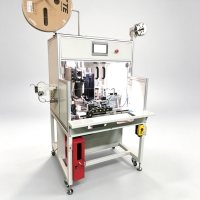
ZX586 Automatic Fakra Cable Production Line (7m Standard Model)The ZX586 Fully Automatic Fakra Production Line is a cost-effective automated single-end processing machine for Fakra cables. It covers the full workflow including manual wire feeding, outer jacket stripping, copper buckle terminal crimping, inner conductor stripping, center terminal crimping, housing terminal crimping, and a full set of inspection procedures. Compatible with a wide range of materials, it enables quick product changeover. 
收藏
Product Description
Human-Machine Operation System:The touch screen HMI features a concise and rational layout for quick operator mastery. All parameters can be easily set and stored, with multi-level password protection covering four access roles: Manufacturer, Engineer, Administrator and Operator. Fault indicator lights and fault codes are provided to facilitate troubleshooting. A movable tablet PC is equipped to simplify maintenance and cut costs.Database Storage Function:The production line collects full production data and reserves communication interfaces for MES, enabling upper-level systems (MES or ERP) to extract data for full product traceability of processing records. Data is auto-overwritten cyclically with a 1-year retention period; extended storage requires additional hard disk expansion.Complete Machine Transfer Mechanism:Reciprocating transmission driven by servo motors paired with slide rails,Secondary positioning via air cylinders at each workstation,Crimping stations: servo drive + air cylinder wire clamping mechanism,Non-crimping stations: Y-axis independent movement for workstations.Advantages of Machine Transfer System:Ultra-precise positioning with a transfer tolerance as low as 0.02 mm,Stable mechanical structure without vulnerable consumables such as belts or drive rollers,No dedicated transfer jigs required, delivering a simple structure for easy maintenance. Product Parameters
相关商品
|